I'm totally not plugging myself, what would make you think that? Seriously, though, these show that it works, and I haven't disabled my lockout chip, so other than the extra resistor, the whole NES is stock.
Is there some schematic or diagram of some sort that shows where to solder what pins to where from the expansion port? I'm not exactly sure what to search up, or I wouldn't be asking. I might be willing to give it a shot on my NES. I might one day just buy a Famicom though.
Edit: Nevermind, I just looked at the first page. I'll have a look at that later.
Edit 2: I looked on Ebay and a bunch of Famicom's for sale there (apparently there's one from 1891 lmao). The first on the list is about $105 total. That's not bad I guess, but then the Famicom only has RF, so I'd need to do a composite/audio mod. On the other hand, I could just mod my NES with that resistor and be good since I can already record video and/or audio from my NES since they have composite/mono audio already. Wowzers =\
Right, step 1 completed: I've got my NES! And, I've already taken the endeavour of taking it apart. Some of the screws in there must've gathered rust because I had a really, really hard time taking them out. Nevertheless, I managed to get to the PCB itself and I've identified the target pins. I think I'll wait until I actually get my Power Pak to do the soldering job, though. ~J-@D!~ proposed to help me by doing it for me, but he's a busy man and I don't know if he'll find the time to drive all the way from Sherbrooke, QC just to do that for me, so I might end up having to do it myself anyway. Oh well, we'll see how that goes!
I actually got a pretty sweet deal on the NES too, considering how rare they are here in Quebec. I paid $70 CAD for the system (in its original box!) plus two controllers plus Super Mario Bros+Duck Hunt, Super Mario Bros. 2 and Super Mario Bros. 3. They're probably cheaper down there in the States, but I'm satisfied with my business anyway.
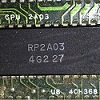
My new avatar is a picture of the 2A03 chip in my new NES!
The bad news is I'll probably have to wait a bit before I order my Power Pak. I've had to pay for some other, more essential things and my bank account is getting a bit dry at the moment, so I don't have $187 USD to splurge on a Power Pak right now. :\
I'm sure it will go well; I've already opened my up several times (once to service the cartridge connectors & twice to take oscilloscope measurements for a project during college). It's one of the easiest systems to work with (which is, I guess, why it's so widely documented, emulated & taken advantage of for hardware hacks).
As for screws; mine not only had the rust, but also had Loctite & even a couple of spider cocoons in the screw posts (it was a hand-me-down from one of my cousins). One thing's for sure; keep some rubbing alcohol & lots of cotton swabs when working with used hardware.
Which reminds me; it's a good idea to take up basic electronics skills if you have the time. In something like this (& other projects,) this can really pay off.
_______________________
Technology: the one thing that's hated & cursed at by all engineers, technologists, scientists & technicians!
My new avatar is a picture of the 2A03 chip in my new NES!
I wish I had thought of that! It's beautiful!!!
Wow, I didn't expect it to attract so much awe. :p
Here's the full-resolution picture if you want it: Link
TechEmporium wrote:
jrlepage wrote:
Oh well, we'll see how that goes!
I'm sure it will go well; I've already opened my up several times (once to service the cartridge connectors & twice to take oscilloscope measurements for a project during college). It's one of the easiest systems to work with (which is, I guess, why it's so widely documented, emulated & taken advantage of for hardware hacks).
Yeah I thought it was super easy to take apart and reassemble, bar the rusty screws, even though I've never taken anything apart other than a laptop ever.
TechEmporium wrote:
As for screws; mine not only had the rust, but also had Loctite & even a couple of spider cocoons in the screw posts (it was a hand-me-down from one of my cousins). One thing's for sure; keep some rubbing alcohol & lots of cotton swabs when working with used hardware.
Duly noted. I know I used rubbing alcohol to remove thermal paste residue from my old laptop GPU (the same laptop I mentioned earlier) but it wasn't concentrated enough. What concentration would you suggest for working with electronics?
TechEmporium wrote:
Which reminds me; it's a good idea to take up basic electronics skills if you have the time. In something like this (& other projects,) this can really pay off.
Yeah, if anything it's got me interested. I took an advanced science course back in secondary school, but that was some time ago (2006, to be exact), and forgot most of it. Resistors are actually one of the few things I remembered from that class... :\
I hear people use a mixture to clean old electronics. 50% water and 50% isopropyl alchohol or something like that. Come to think of it, I myself have used standard Window cleaner (Windex) to clean all my old cartrage contacts (NES, GB, GBA, Gen, SNES, TG16 etc. all with contacts) and console pins in the cartrage slots and it all works like a charm. Not sure about cleaning the whole motherboard. I just use a very soft dry brush to wipe out any dirt and dust. Cleaning the surface of the consoles is something I need to get around to doing.
I found an NES on eBay for $50 (+$18 shipping). I was kind of surprised how much they're going for. I've seen Genesis/SNES/PS1 regularly sell for far less than that.
And now I burn with anticipation while it's in the mail, and my PowerPak is in production...
I found an NES on eBay for $50 (+$18 shipping). I was kind of surprised how much they're going for.
Yeah, my local classic gaming shop sells them for $49.99 + tx, with no box, no games, just two controllers. That's why I thought I made pretty good business getting an NES in its original box with SMB 1+2+3 and two controllers for $70 (no tax)!
Duly noted. I know I used rubbing alcohol to remove thermal paste residue from my old laptop GPU (the same laptop I mentioned earlier) but it wasn't concentrated enough. What concentration would you suggest for working with electronics?
I'd recommend anywhere between 70% (like you'd get at a pharmacy) & 100% (i.e.: portable barbecue fuel).
_______________________
Technology: the one thing that's hated & cursed at by all engineers, technologists, scientists & technicians!
Woot! It finally arrived. NES, 2 controllers, zapper, RF, power, SMB + Duck Hunt. It's a bit dirty, and the tray doesn't stay down, but it works great!
And my PowerPak just shipped today. It is a glorious time to be alive.
Woot! It finally arrived. NES, 2 controllers, zapper, RF, power, SMB + Duck Hunt. It's a bit dirty, and the tray doesn't stay down, but it works great!
And my PowerPak just shipped today. It is a glorious time to be alive.
Awesome!! Out of curiosity, how long is the delay between ordering and shipping?
I've been testing the composite video out. Originally I thought I'd never need the RF out (since my TV's cable input is a bit crummy, makes a very dirty picture) but then I realized if I want to do video capture, it's really great that there's two video outputs so I can see what I'm doing on a TV while I record. Also, the RCA audio comes out way cleaner/brighter than what my TV gets through the RF-cable adapter.
One thing I noticed that I find really weird about the composite output, is that there seems to be a stairstep gradient on coloured pixels (grey/white ones don't do this), it's about 16 pixels wide and has about 15 steps in it. Sort of a sawtooth brightness pattern across a scanline, and it reverses every scanline. I can only see it on my LCD TV, on video capture or my computer monitor I think it's there but it comes out very faint. Maybe something in the circuitry of my TV is sensitive to something weird the NES is doing? (By comparison, the composite out from my PS3 shows nice and clean on my TV, so... I dunno.)




 )
) 
